
MediaValet
High growth, high retention, however, not profitable. Hot DAM or Hot mess?

Summary
Canada listed SAAS (Software as a service) company, with a large array of features for their DAM storage system.
Benefits from favourable market growth and increasing amount of “greenfield” opportunity.
Currently not cash positive, but will be by analyst expectation by the end of the year.
5-year ARR (annual recurring revenue) CAGR 43% and net retention 100%+
Well-funded for the foreseeable future, with $5.8M of Adj Working capital, including a $3.5M equity raise by insiders from Jan 2023, and a $9M LOC (Line of Credit)
Trading at around EV/ARR of 2.9 and exp ’23 EV/ARR of 2.3
MediaValet inc.
Most people reading this article have used google drive or dropbox. Now imagine you are a large company, really any large company, you have a marketing team, a sales team and a tech team. They will all need to have digital pictures, graphs and videos to do their work. But if you have thousands of people working and thousands of files that will sum up to sometimes terabytes of data, not something your ordinary google drive or dropbox could handle.
You can compare this company as an enormous version of google drive of dropbox, since some of their clients can have millions of videos, pictures or graphs. This Digital Asset Management (DAM) allows these companies to upload massive amount of data and map them, store them, sort them, and for example tag the photos or videos. The company also brings in more proprietary features into the database, this will be mentioned later on.
A DAM file management system focuses on the ability to manage, store, edit and organize the visual contents. The companies do not store text documents or contracts, they store photos, videos and for example graphs. All In 1 central place, the cloud, were everybody in the company can access all the data.
According to MediaValet their investor relations there are three key features of DAM:
Sophisticated Organization & Search: A DAM makes storing, managing, and finding brand and marketing material (photos, videos, etc.) easy with artificial intelligence, keywords, and advanced search capabilities.
Advanced Asset Security: Access permissions for internal and external users give organizations tighter rein on digital media. A DAM offers version control, history tracking, and watermarks, as well as enhanced security and compliance.
Better Media Sharing: A DAM includes features that enable easy sharing of large media files, such as high-resolution images, large-format videos, etc., over email, web galleries, or Branded Portals.
MediaValet compared to competition
Dropbox https://www.mediavalet.com/blog/dropbox-vs-dam-whats-the-difference/
Many organizations begin by using Dropbox or a similar file-sharing system, only to find that as they grow, they need a more robust solution to manage their content—especially their rich media.
While organizations gain vast benefits from upgrading to a DAM, here are a few noteworthy features:
Previewing
Asset Rendering and Resizing
Searching
Support and Training
Google drive
While many organizations begin with storing their files in a free cloud-based system like Google Drive, they often find that as they grow, they need a more robust solution to manage their content – especially their rich media. While organizations gain vast benefits from upgrading to a DAM, here are a few noteworthy features:
Category Access Management
Previewing
Asset Rendering and Resizing
Advanced Search
Support and Training
Data Security
OneDrive
The main difference between OneDrive and a digital asset management system can be seen in the types of files they specialize in. OneDrive is a great platform to collaborate on document-based content (Word, Excel, PowerPoint, etc.) and provide a central workspace for team members. DAM, on the other hand, extends this workspace to a greater degree by adding the ability to better manage large, media-based files in a single, centralized library, secured through access rights and permissions.
Key Differences
OneDrive is more document-focused, designed for collaboration and communication among team members, where DAM focuses on the organization and control of digital assets (photos, videos, etc.)
DAM is a much broader tool than OneDrive, as it allows users to perform a variety of functions within the system while also making it easy to share digital files internally and externally.
OneDrive offers only one primary location for users to share and edit their assets, where DAM allows users to share and edit their assets in multiple different applications through integrations.
Revenue and profit
Revenue is normally a very reliable indication of how the business is performing. With MediaValet this is not the case, revenue is a lagging indicator of business performance. In this case MediaValet also reports billings separately, this is a way more valuable metric to use.
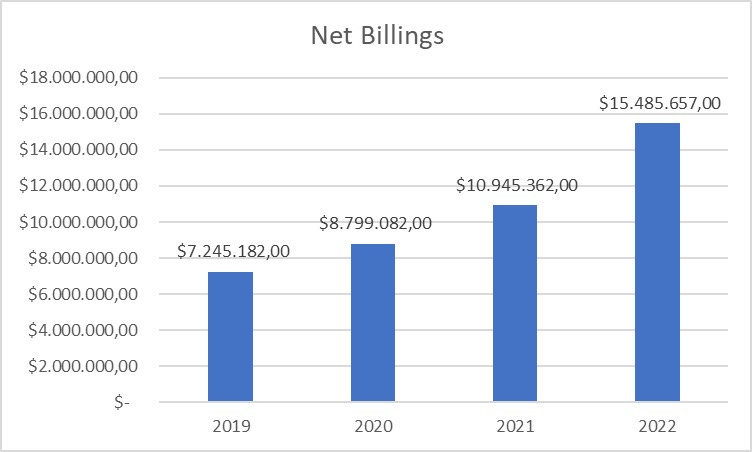
When companies sign a contract with their clients, they prefer to sign a one-year contract. Clients can choose to go for a multi-year contract, but normally they also chose a one-year contract. A contract consists of a two-part payment, an upfront cost for instalment and the entire amount of the contract.
This leads to a large amount of liability on the balance sheet, deferred revenue.
Contracts usually range from the low end of about 6000$ USD for a small business to about 700,000$ USD for a large company. Retention was 101% in dollar amounts for 2022. Management has expressed that long-term goal for net retention is 105%-110%. Their average ARR per customer was about $22k at the beginning of the year. When they announce a new client via the IR page, the client is at least two times the average ARR, this gives investors an insight into the momentum of new clients.
New clients also pay a service to install and make everything ready for use, if they extend the contract this is not charged a second time.
Competition
The largest competition for MediaValet is their clients doing their assets storage inhouse, by using any of the available online storage methods or if they are large enough making their own system. They have experienced this with their larger clients, that they chose to try and do it inhouse. With smaller clients this is less of an issue, since such an undertaking takes a lot of capital and technical skills.
Other companies who compete in the space are Adobe, Widen, Webdam and Bynder. Bynder bought Webdam to become a larger player in the DAM business. Acquia is a competitor of Bynder and because Bynder bought Webdam, Acquia bought Widen.
The point with the previously mentioned competitors is that they are not integrated as much as MediaValet is in the company. Most competitors offer more features but non are customizable or they lack the depth that the company needs. MediaValet builds new applications If a client needs it. They can focus on the clients’ needs.
Other competitors are overly customizable, they have for example ¼ of the clients but their revenue is 50-100 million dollars, that means that the average ARR is up to 1 million USD. These do no compete with MediaValet for most companies.
Advanced MediaValet features
One of the main reasons clients use MediaValet or chose to do business with, is because of their advanced features and their willingness and ableness to expand these features if clients ask for them. As management has said a lot of times that they need to invest in R&D to make a moat and invest even more into R&D to deepen their moat.
“Our product and R&D teams have an exciting lineup of new releases and enhancements in the year ahead. This includes launches in the areas of user experience and new features to increase customer value and collaboration. In addition, we are continually enhancing our back-end capability and optimizing it to handle larger customers and the mass volumes of data that we expect to see as DAM continues to rise in importance.”
All the features they have you can find on their site, an example of this feature would be object detection and the example can be found here.
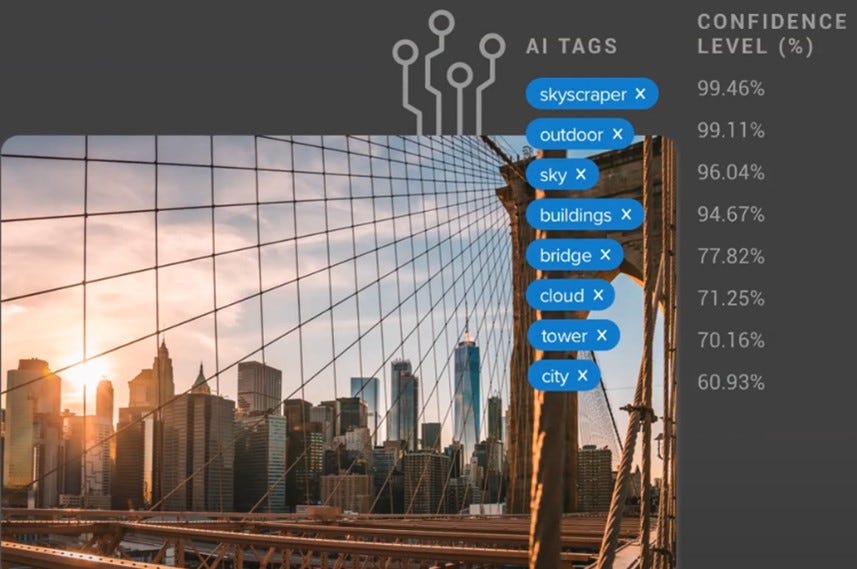
Other key features found on MediaValet their site:
Colour and test recognition
Access Controls/Permissions
Unlimited Users and support
Asset Categorization, library and sharing
Customizable Branding
Metadata Management
Reporting/Analytics
Search/Filter
Version Control
Workflow optimization
What adds to this features is the seamless integration MediaValet has with companies that offer all kinds of services:
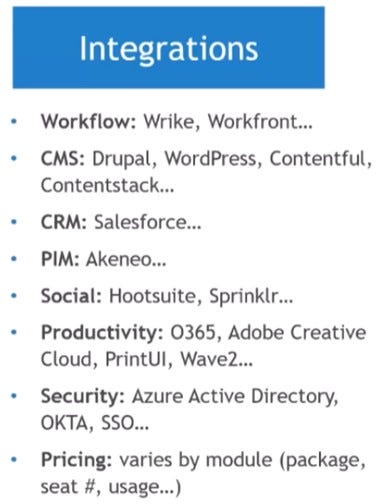
By adding these companies and especially features like Salesforce, WordPress, Adobe and more you can add a lot of value to your offering.